Introduction
Athena Vortex Lattice (AVL) is a low-order computational tool used for aerodynamic analysis and the evaluation of aircraft stability and control. The program applies the vortex lattice method to calculate lift, induced drag, aircraft moments, and stability derivatives. Despite its computational efficiency, the conventional use of AVL requires users to prepare text-based input files and manually enter a sequence of commands for each operating condition. Consequently, conducting parametric studies involving many configurations can be time-consuming and susceptible to input errors.
Therefore, a Python-based application was developed to connect the user with AVL through a graphical user interface. The application automates aircraft model generation, analysis execution, result extraction, and data visualization. It enables users to modify the aircraft geometry, operating conditions, and control surfaces without manually writing AVL input files or repeatedly entering commands.
Methodology
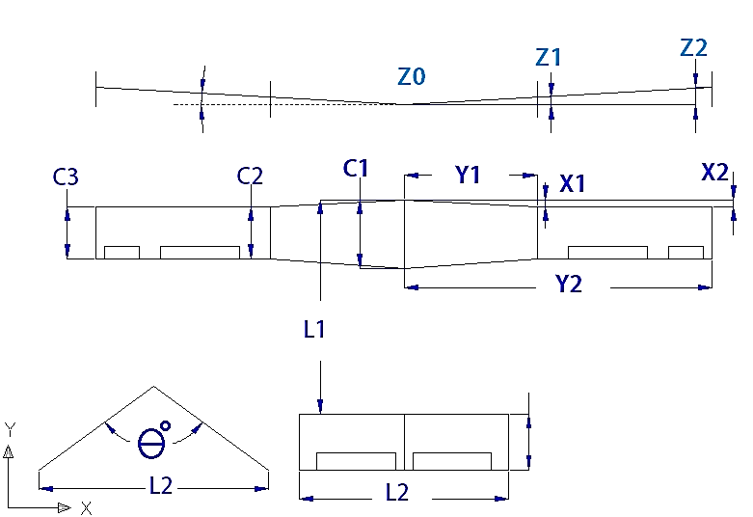
The application was developed using Python, while the Tkinter library was used to create the graphical user interface. The interface enables the user to enter the aircraft’s geometric and operating parameters, including the wing area, wingspan, root and tip chord lengths, wing position, and incidence angle. It also allows the user to define the dimensions, position, and cant angle of the V-tail relative to the aircraft coordinate system.
The application also supports the definition of control surfaces, including the ailerons and V-tail control surfaces. The two V-tail surfaces can be deflected in the same direction to generate a pitching control input or in opposite directions to generate a yawing control input. This capability allows the effects of control-surface deflections on the generated aerodynamic forces and moments to be investigated.
After the required data are entered, the application automatically generates an aircraft geometry file in a format compatible with AVL. The generated file contains the aircraft reference parameters, lifting-surface coordinates, panel discretization settings, and the locations and control gains of the control surfaces. Python then launches the AVL executable and automatically sends the required sequence of commands to the solver.
The user can specify the required angle-of-attack range and the step size between consecutive operating points. The application performs a separate analysis at each angle of attack and saves the corresponding aerodynamic force and moment files. After completing the analysis, Python reads these files and extracts the principal aerodynamic parameters, including:
- Lift coefficient.
- Induced-drag coefficient.
- Pitching-moment coefficient.
- Lift-to-drag ratio.
- Stability derivatives.
- Effects of control-surface deflection.
- The predicted trim angle within the analyzed range.
The extracted results are organized and saved in a CSV file. They are subsequently displayed as plots showing the variation of lift, induced drag, pitching moment, and aerodynamic efficiency with the angle of attack. The results can also be used to compare different aircraft configurations or operating conditions through a consistent analysis procedure.
Results
Linking Python with AVL transformed the analysis process from a sequence of repetitive manual operations into an automated computational framework. The aircraft model, angle-of-attack sweep, result extraction, and graphical visualization can be managed through a single interface. This reduces the model preparation time and minimizes errors associated with manually writing input files, entering commands, or transferring results.
The application also enables rapid parametric studies. A geometric parameter, such as the wingspan, chord length, wing incidence angle, or tail dimensions, can be modified before rerunning the analysis and comparing the new results with those of the previous configuration. This capability can be used to evaluate the influence of individual design variables on lift, induced drag, aerodynamic efficiency, and longitudinal stability.
Furthermore, the application provides a practical method for evaluating control-surface effectiveness. By changing the deflection angles of the ailerons or V-tail control surfaces, their effects on the aerodynamic forces and moments can be determined, allowing the aircraft’s trim and its pitch and yaw control capabilities to be assessed.
The principal benefits of the application include:
- Reducing the need for direct interaction with the AVL command-line interface.
- Automatically generating aircraft geometry and run files.
- Performing consecutive analyses over a specified angle-of-attack range.
- Extracting aerodynamic force and moment coefficients automatically.
- Saving the results in organized files for subsequent analysis.
- Directly generating aerodynamic-performance plots.
- Rapidly comparing different aircraft configurations and operating conditions.
- Investigating the effects of geometric parameters and control surfaces.
- Supporting preliminary aircraft design and engineering decision-making.
- Providing a foundation for future integration with automated aircraft optimization methods.
Therefore, the developed application provides an effective design and analysis platform that combines the computational efficiency of AVL with the flexibility of Python for automation, data processing, and result visualization. It can be used in academic research and the preliminary design of unmanned aircraft, particularly when many configurations and geometric parameters must be evaluated within a limited period.