I’m having a really hard time understanding the following statement in the PX4 documentation:
“For a VTOL Tailsitter airframe set the vehicle orientation according to its multirotor configuration (i.e. relative to the vehicle during takeoff, hovering, landing) for all sensor calibrations.”
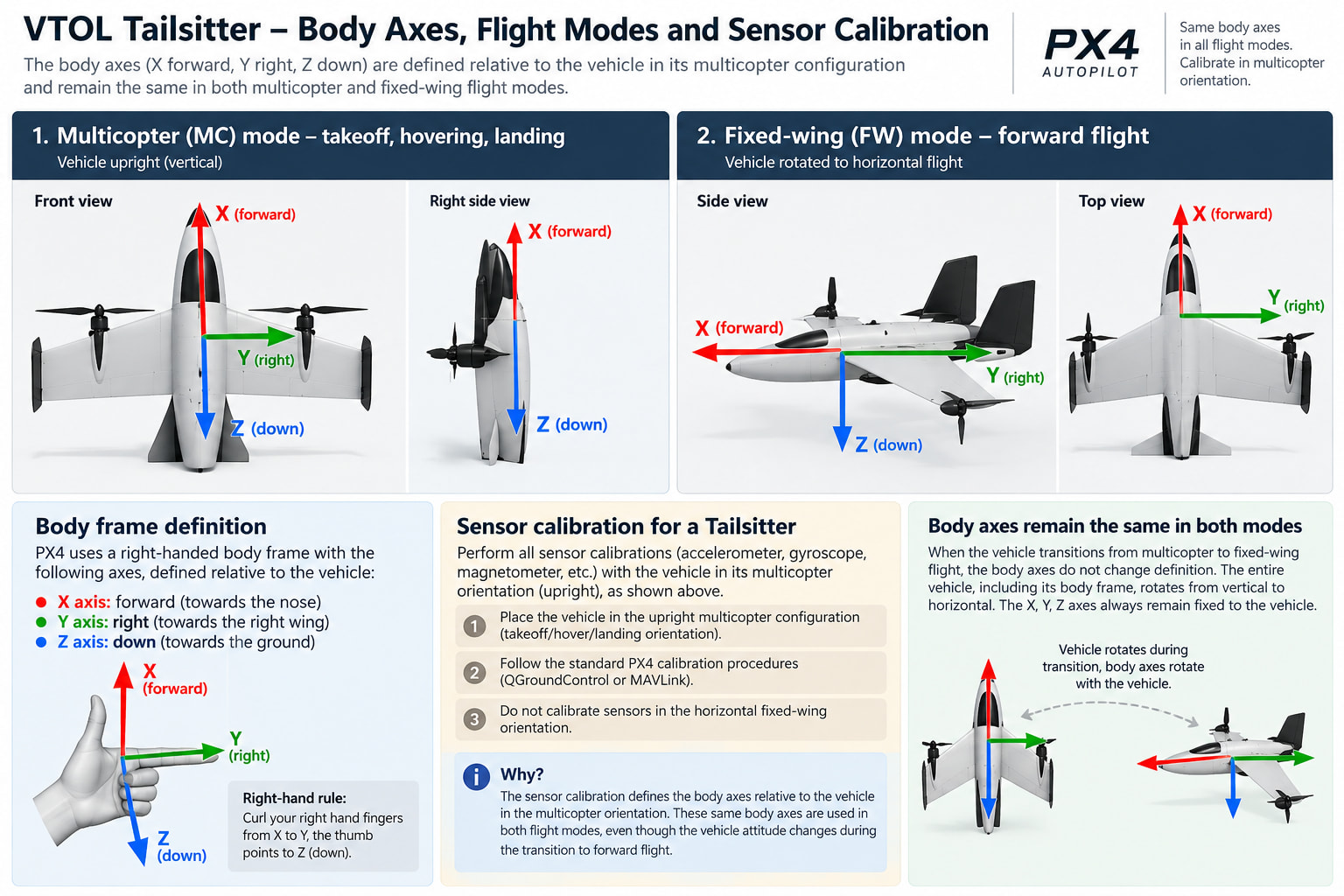
Could someone please provide a simple drawing of a tailsitter in two configurations?
Multicopter (MC) mode: during takeoff and hovering.
Fixed-wing (FW) mode: during forward flight.
Please mark the X, Y, and Z body axes on the vehicle in both drawings.
I want to understand how the body axes are oriented relative to the vehicle in each flight mode and how this relates to the sensor calibration instructions.
The key point is that PX4’s tailsitter calibration instruction refers to the vehicle’s multicopter orientation, not to redefining the body axes every time the aircraft changes flight mode.
For sensor calibration, use the tailsitter’s upright multicopter configuration the orientation used for vertical takeoff, hovering and landing.
The body coordinate frame is fixed to the vehicle. When the aircraft transitions to horizontal fixed-wing flight, the body axes rotate with the aircraft; they do not remain fixed relative to the ground.
This distinction is particularly important when interpreting the X-forward, Y-right and Z-down convention. These directions describe the vehicle’s body frame, not three directions that must always align with the surrounding world.
Also make sure the flight controller’s physical mounting orientation is correctly represented in PX4 before performing the standard sensor calibration procedure.